3D Printer Rapid Prototyping: In-House or Outsource?
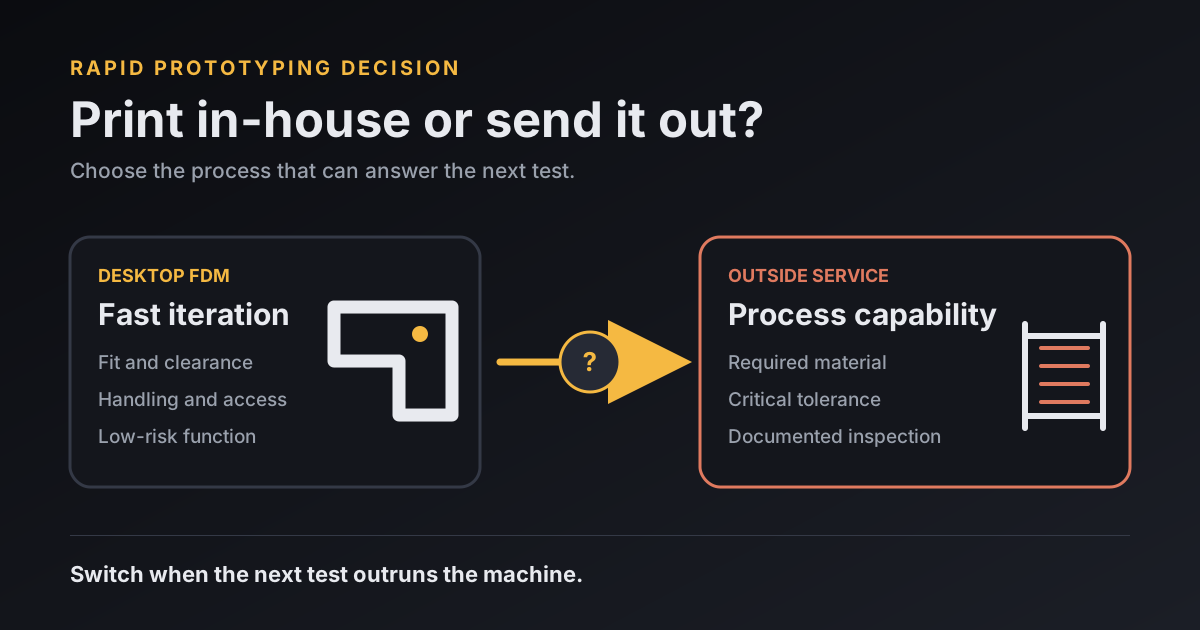
3D printer rapid prototyping is the fast cycle of printing, checking, and revising physical parts from a digital model. Use a desktop FDM printer when the part fits the build volume and the next question concerns shape, fit, handling, or a low-risk function its material can represent. Outsource when material, tolerance, finish, size, inspection, or load evidence exceeds what that machine can demonstrate.
When is a desktop FDM printer enough for rapid prototyping?
A desktop FDM printer is enough when its output can answer the next design question with a measurement you trust.
| Question to answer | Keep it in-house when | Send it out when |
|---|---|---|
| Does the shape fit the assembly? | The printer can make the mating features and you can measure the fit. | The interface needs tighter capability or formal inspection. |
| Can someone hold or operate it? | Size, reach, clearance, and handling are the real test. | Surface finish or exact weight controls the evaluation. |
| Will it survive the load? | Your filament, orientation, fixture, and test reproduce the service condition. | The final material, isotropy, certification, or process is unavailable in-house. |
| Can it be shown to a stakeholder? | Layer lines and a simple finish do not change the decision. | Fine detail, transparency, color, or presentation finish affects approval. |
| Can we repeat the result? | You can print, measure, and record enough copies consistently. | Quantity or inspection would consume the printer and operator needed for other work. |
The National Institute of Standards and Technology says additive manufacturing fabricates parts layer by layer from digital designs. That method makes revisions quick, but the printer doesn't define the test. My 3D-printing notes mention functional parts, custom mounts, and brackets because those are useful desktop jobs. Each one still needs a written reason for being printed.
What makes in-house 3D printing the faster choice?
In-house 3D printing is faster when the design will change several times and each print can answer a narrow question before the next revision.
A small fit coupon can expose a misplaced hole without waiting for a polished full part. The useful loop is short: slice the smallest representative geometry, print it, measure the named feature, update the model, and repeat. Keep the material and orientation consistent when you want results to be comparable.
Formlabs recommends keeping frequently used prototyping tools in-house and outsourcing larger parts or work that needs non-standard materials or complex machinery. That advice comes from a 3D-printer manufacturer describing its own rapid-prototyping workflow, so I treat it as a decision pattern rather than an independent cost guarantee.
FDM also makes sense when rough surfaces are harmless. A bracket used to check screw access doesn't need a cosmetic finish. A handheld shell used to judge reach and button position may only need the correct outer shape. The FDM process guide explains why filament printing usually fits affordable, repeatedly revised parts.
What failure should force a prototype outside?
A prototype should move outside when a measured failure survives a fair reprint or when the next requirement cannot be represented by the desktop process.
First rule out setup mistakes. Confirm the file revision, machine profile, material, orientation, measurement method, and instrument. A failed dimension caused by the wrong model does not justify a new manufacturing process. A repeated miss on a critical feature, using a controlled setup, is useful evidence.
The switch can happen without a broken part. A fit model may pass, then the next test may require flame behavior, optical clarity, a documented alloy, pressure tightness, or inspection data that the desktop material cannot supply. At that point another FDM reprint answers the old question again.
How does one bracket failure trigger the handoff?
The bracket handoff begins with a failed critical dimension, then compares the requirement with a supplier's published process capability.
The repository does not identify a measured real-world bracket failure, so I use the existing prototype test-plan page's labeled fictional case instead:
Suppose a sensor bracket must place two pins 50.0 ± 0.2 mm apart and accept an M4 fastener through a 4.2 mm clearance hole. Print a coupon containing the holes before the whole bracket, measure it with calipers, and test the actual pin and screw. If the measured spacing is 50.3 mm, the result fails even if the screw can be forced through.
The acceptable band is 49.8 to 50.2 mm. The 50.3 mm reading sits 0.1 mm beyond the upper limit. I would repeat the measurement, check the calipers, confirm the model, and print another coupon in the controlled orientation before changing processes.
If the repeat also fails, I would send the controlled result with a service quote request. Protolabs publishes its typical SLA X/Y tolerance as ±0.002 inch (±0.0508 mm) for the first inch, plus 0.1% of the nominal dimension. For a 50.0 mm feature, that supplier formula gives ±0.1008 mm, calculated as 0.0508 mm + 0.0500 mm. The published number is tighter than the bracket's ±0.2 mm requirement on paper.
That calculation does not promise a passing bracket. Protolabs also says geometry and orientation affect its tolerances. The example supports asking that supplier whether its SLA process can inspect this feature; it does not prove another service, another process, or the finished assembly will pass. The bracket values are a reproducible planning example, not a verified customer job or physical result from my printer.
What should you send to an outside 3D-printing service?
An outside 3D-printing service needs the model, the few requirements that control success, and the evidence from the in-house failure.
- Name the geometry file and revision so the quote, print, and inspection all refer to the same model.
- Put tolerances on the interfaces that matter instead of tightening the entire drawing.
- State the property the material must represent and any surface that affects fit or evaluation.
- Separate one test part from a pilot batch and give the actual need date.
- Ask what will be measured, with which report, and whether the quoted tolerance applies to the geometry and orientation.
- Include the in-house measurement, process, orientation, and test method so the supplier knows what the new process must improve.
A supplier cannot infer the important surface from an STL alone. Mark the pin spacing, sealing face, thread, snap, load direction, or finish that decides the test. Ask for a revised quote if the supplier proposes a process or material change.
How do cost and speed affect the print-or-outsource decision?
Cost and speed favor the option that answers the current question with the least total delay, including operator time, failed attempts, shipping, and inspection.
Filament price alone can make an in-house part look cheap. Count setup, machine occupancy, cleanup, measurement, and the time spent diagnosing misses. For the outside quote, count lead time, shipping, supplier communication, and the possibility of another revision. A service part that arrives later but closes the material or tolerance question can be faster than a week of local reprints.
I use a simple gate: keep printing locally while each iteration produces new evidence the desktop process can represent. Send the part out when another local print would repeat a known limit. That keeps rapid prototyping focused on learning instead of keeping a printer busy.
What do people ask about 3D printer rapid prototyping?
People comparing rapid-prototyping options usually ask where 3D printing fits, which printer to use, when to outsource, and what an outside service needs.
Is 3D printing the same as rapid prototyping?
3D printing is one way to make parts during rapid prototyping. Rapid prototyping is the wider cycle of building a test piece, measuring it, revising the design, and repeating until the evidence answers the design question.
Which 3D printer is best for prototyping?
The best 3D printer for prototyping is the one that can reproduce the property you need to test. Desktop FDM often fits quick size, fit, and handling checks; another process may be needed for fine detail, a specific material, tight tolerance, or documented inspection.
When should you outsource a 3D-printed prototype?
Outsource a 3D-printed prototype when its required material, tolerance, finish, size, quantity, inspection, or test evidence falls outside the capability you can verify on your own printer.
What should you send with a 3D-printing quote request?
Send the revision-controlled 3D file, a drawing of critical dimensions and tolerances, material and finish requirements, quantity, needed date, intended test, and the inspection record you expect. Include the failed result when it explains why the process must change.